PRNewswire
Singapore, September 16: Visa (NYSE: V), a global leader in digital payments, today released the Asia Pacific findings from its Money Travels: 2026 Digital Remittances Adoption Report, revealing continued growth in digital cross-border money movement across the region. The findings show that remittances continue to play an important role in helping consumers support family members, manage everyday expenses and navigate financial emergencies, while trust, security and transparency are becoming just as important as speed and convenience in shaping payment experiences.
The study, which surveyed more than more than 45,000 remittance senders and receivers across 20 markets, including Australia, Mainland China, India, Japan, the Philippines and Singapore, found growing adoption of digital cross-border payments alongside rising expectations for trusted payment experiences. For the first time, this year's study also included a dedicated module examining consumer awareness, perceptions and adoption intent towards stablecoins, finding that education and confidence will be key to broader adoption amid growing concerns around scams, fraud and AI-enabled threats.
"Cross-border money movement is fundamental to how people, businesses and economies connect across Asia Pacific," said Chavi Jafa, Senior Vice President, Head of Commercial and Money Movement Solutions, Asia Pacific, Visa. "Financial institutions have an opportunity to make cross-border payments a more integrated and valuable part of the overall customer experience as consumer expectations continue to evolve, with customers increasingly looking for solutions that combine speed, security, convenience and flexibility. Building trust through education, transparency and security will be critical to the next phase of adoption."
Key findings for Asia Pacific
Cross-Border Payments Remain Essential Across Asia Pacific
- Remittance activity varies significantly across the region, with the Philippines (45%) and Australia (35%) reporting the highest proportions of consumers sending money abroad, compared with Japan (8%). Receiving rates are also highest in the Philippines (45%) and lowest in Japan (5%).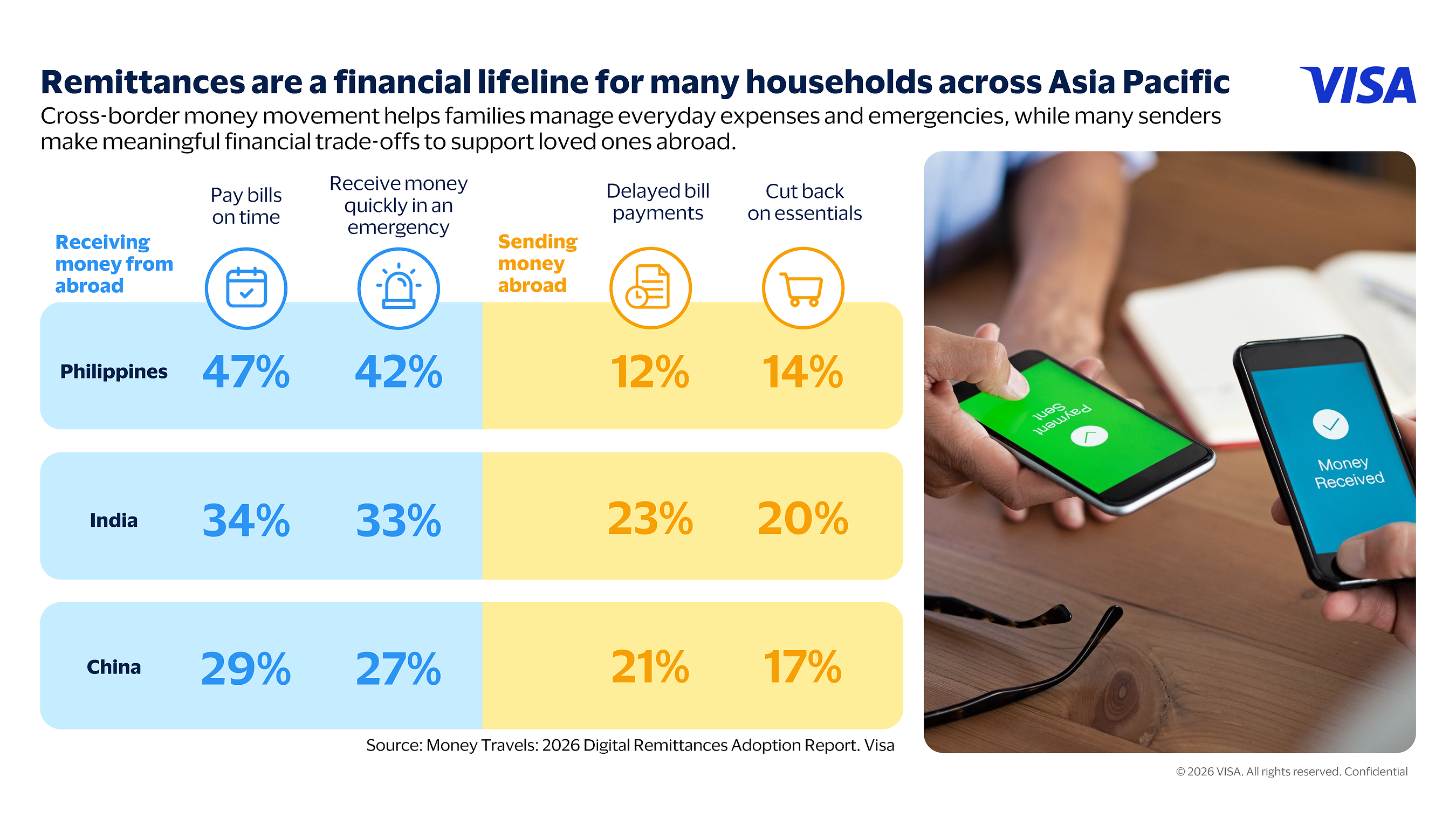
- Cross-border payments continue to support everyday financial needs, from household expenses to emergency funding and family support. Paying household bills is a key reason for receiving remittances in the Philippines (47%) and India (34%), while financial emergencies are a leading use case in the Philippines (42%) and India (33%).
- Supporting loved ones can come at a personal cost, with consumers in India (23%) and Mainland China (21%) delaying bill payments, while those in India (20%) and Mainland China (17%) cut back on essentials to provide financial support abroad.
Consumer Expectations Continue to Shift Toward Digital Experiences
- Mobile banking apps remain the preferred way to send money internationally across Asia Pacific, with usage ranging from 33% to 60% across markets.
- Mobile wallet adoption is particularly strong in India (36%), the Philippines (28%) and Mainland China (27%), highlighting growing consumer preference for digital-first money movement experiences.
- Digital adoption continues to vary across markets, with Japan (32%) remaining the regional outlier, where nearly one-third of consumers still prefer making international transfers through physical bank branches.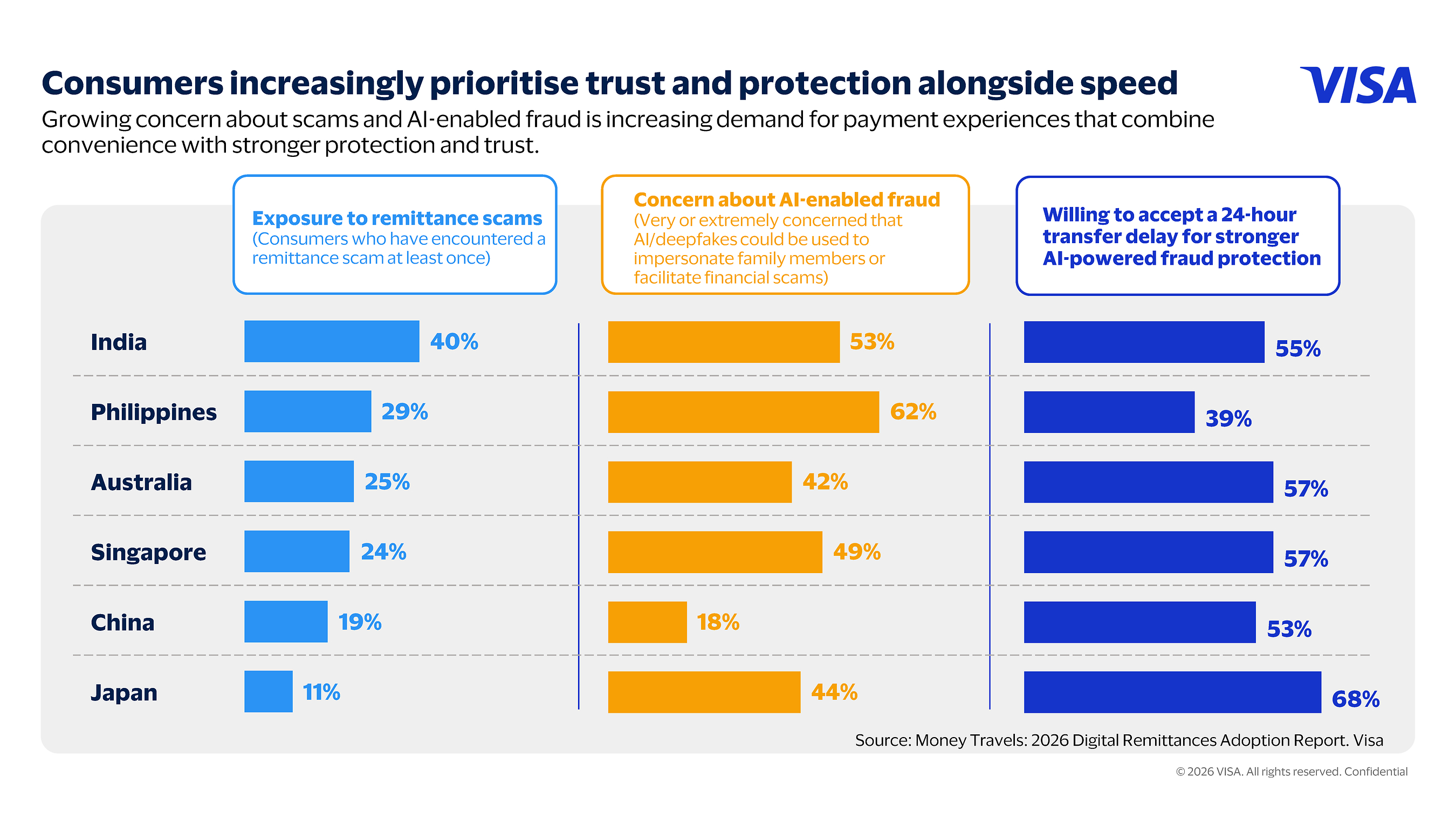
Security and Fraud Concerns Are Shaping Consumer Behaviour
- Exposure to remittance scams is highest in India (40%) and the Philippines (29%), compared with China (19%) and Japan (11%).
- Concern about AI-enabled fraud is particularly pronounced in the Philippines (62%) and India (53%), where consumers worry that deepfakes could be used to impersonate family members or facilitate financial scams.
- Consumers increasingly prioritise protection over speed, with Japan (68%), Singapore (57%) and Australia (57%) willing to accept a 24-hour transfer delay in exchange for stronger AI-powered fraud protection.
Consumers Are Open to Emerging Payment Innovations, but Education Remains Critical
- Awareness and trust vary widely across the region. Consumer interest in stablecoins increases significantly when respondents better understand that stablecoins are designed to maintain their value and may offer additional benefits.
- Misconceptions remain widespread across Asia Pacific, with roughly half of consumers believing stablecoins are as risky as or riskier than cryptocurrencies despite being designed to maintain a stable value.
"The findings underscore how diverse payment behaviours, preferences and levels of digital adoption continue to accelerate across Asia Pacific," said Rhidoi Krishnakumar, Vice President, Head of Visa Direct, Asia Pacific, Visa. "For banks, remitters and fintechs, the opportunity lies in delivering seamless cross-border experiences while managing growing complexity on behalf of clients. Through Visa Direct, we work with partners across the region to help simplify this complexity and enable money movement experiences that are more seamless, scalable and locally relevant to how consumers and businesses move money today."
The findings highlight how cross-border money movement continues to evolve across Asia Pacific, shaped by growing digital adoption, changing consumer expectations, emerging payment innovations and rising demands for security and trust. For banks, remitters and fintechs, understanding how these trends are reshaping consumer behaviour will be increasingly important in delivering relevant, trusted and future-ready money movement experiences.
To learn more about the trends shaping cross-border money movement across Asia Pacific, explore the Money Travels 2026 findings here.
Note on Methodology
Findings are based on self-reported consumer survey responses. Respondents received definitions of key terms, including stablecoins, before answering. Survey scenarios involving "bank-equivalent protections" or similar concepts are hypothetical. Stablecoins are not currently covered by deposit insurance (e.g., FDIC, CDIC). Findings reflect consumer awareness, attitudes, and stated intent only – not commentary on legal status or operational availability. This report is for informational purposes only and does not constitute financial or legal advice.
About the Study
Money Travels 2026 was conducted by Morning Consult on behalf of Visa between 24 February and 2 March 2026. The findings form part of Visa's global Money Travels 2026 study, which surveyed more than 45,000 remittance senders and receivers across 20 markets to examine remittance behaviours, attitudes and emerging trends in cross-border money movement. The Asia Pacific findings cover Australia, Mainland China, India, Japan, the Philippines and Singapore.
About Visa
Visa (NYSE: V) is a world leader in digital payments, facilitating transactions between consumers, sellers, financial institutions and government entities across more than 200 countries and territories. Our mission is to connect the world through the most innovative, convenient, reliable and secure payments network, enabling individuals, businesses and economies to thrive. We believe that economies that include everyone everywhere, uplift everyone everywhere and see access as foundational to the future of money movement. Learn more at Visa.com.
(ADVERTORIAL DISCLAIMER: The above press release has been provided by PRNewswire. ANI will not be responsible in any way for the content of the same.)